Why Pressure Washing Is Required Before Exterior Painting
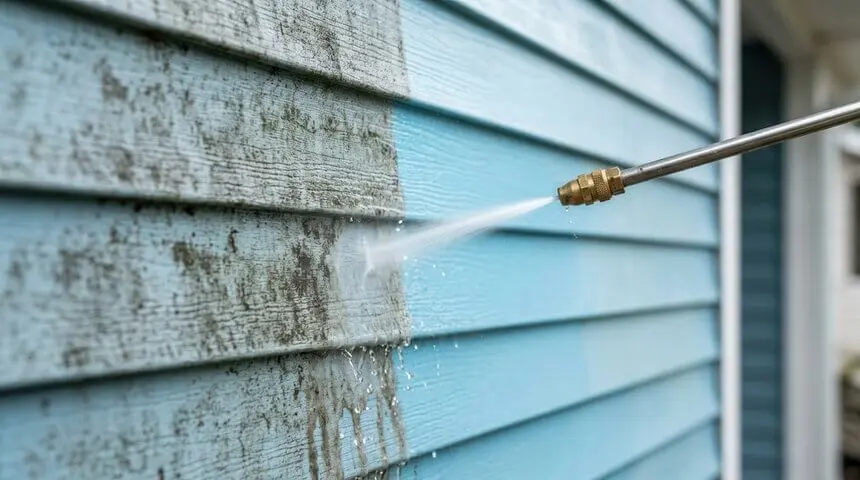
When an exterior painting project is on the horizon, pressure washing often comes up as part of the process. Some homeowners wonder whether it is a genuine requirement or an extra step that can be skipped to save time and money. The short answer is that it is required, and the reason comes down to what is already on the surface before any paint is applied.
What is sitting on that surface when the first coat goes on directly determines whether the paint bonds correctly and how long the finished job holds up. This post breaks down what builds up on exterior surfaces over time, why pressure washing before exterior painting is not optional, and what happens to a paint job when that step gets skipped.
What Builds Up on Exterior Surfaces Over Time
Exterior surfaces take a lot of exposure. Sun, rain, humidity, wind, and biological growth are working on the surface constantly, and over time they leave behind material that is not always obvious from the ground. A surface that looks clean enough to paint almost always has a layer of contamination on it that will interfere with the paint job.
That contamination typically includes a combination of the following:
- Dirt, dust, and environmental debris that settle into the surface gradually and accumulate in textured areas like wood grain, stucco, and siding profiles. This buildup is invisible at a glance but consistent across nearly every exterior surface.
- Mold, mildew, and algae, which are biological growth rather than simple surface staining. These organisms are alive, and they continue to grow after paint is applied over them if they are not removed first. Humid climates accelerate their spread significantly.
- Chalking, a specific condition that develops on older painted surfaces as the paint binder breaks down over time. The result is a fine, powdery residue that sits on top of the surface. Paint applied directly over chalk has nothing solid to grip.
- Salt deposits on homes in coastal areas. Salt accumulates on exterior surfaces through salt air exposure and acts as a barrier layer between the substrate and any new coating applied over it.
The challenge with all of this is that none of it registers as a problem from a normal viewing distance. The surface can appear ready to paint when in reality there is a layer of contamination sitting on it that will affect the outcome of the entire project. That gap between how a surface looks and what is actually on it is exactly why pressure washing is a standard part of professional exterior painting, not an optional add-on.
Why Exterior Painting Requires Pressure Washing First
The reason pressure washing is required comes down to one principle: paint bonds to whatever it touches first.
On a surface that has not been cleaned, the paint never makes direct contact with the actual substrate. It contacts the dirt, mold, chalk, or salt sitting on top of the substrate instead. That layer of contamination becomes what the paint is bonded to, and that bond is not the same as a bond formed directly against wood, stucco, brick, or siding.
Adhesion is the foundation of every exterior paint job. It is not just about whether paint appears to stick on the day it goes on. Adhesion is what determines whether the finish coat holds up through years of temperature swings, direct sun, rain, and humidity. A bond that formed against a contaminated surface rather than against the substrate itself is compromised before the paint even dries.
It helps to think of it this way. If you pressed tape against a dusty wall, it would appear to stick, but the bond would be to the dust rather than to the wall itself. Pull it back and the dust comes with it. Paint behaves the same way at a chemical level. The bond is only as strong as the surface it formed against.
Pressure washing solves this by removing the contamination entirely. Once the surface is clean, the paint makes direct contact with the actual substrate. That contact is what a proper bond depends on.
There is a secondary benefit as well. Pressure washing opens the surface slightly, allowing paint to penetrate into the material rather than sitting on top of it. That penetration improves the grip of the bond and contributes to how the finish holds up over time.
What Happens When Exterior Paint Goes on an Unwashed Surface
When paint is applied over a surface that was not pressure washed, the problems that follow are predictable. They are not caused by poor quality paint or bad weather. They are caused by a bond that was never properly formed.
The most common failures include:
- Peeling and flaking, which often begin appearing within the first one to two years after the project. Paint that bonded to contamination rather than to the substrate starts separating as the contamination beneath it shifts or breaks down further.
- Bubbling, which happens when moisture or contaminants trapped beneath the finish coat push against the paint film from underneath. Instead of holding flat against the surface, the paint lifts and forms visible bubbles across sections of the exterior.
- Active mold and mildew growth beneath the new coat. Biological growth that was not removed before painting does not stop growing once paint is applied over it. It continues spreading under the finish coat, and the discoloration and surface damage eventually push through to the visible surface.
- Uneven finish and premature fading in areas where chalk or debris created inconsistent absorption. In those spots, the paint breaks down faster than surrounding areas, producing a finish that looks patchy and worn well before it should.
These are not random or unpredictable outcomes. Every one of them follows directly from applying paint over a surface that still had contamination on it. The surface condition going into the project determines the outcome coming out of it.
Why Painting Over the Problem Is Not a Solution
A reasonable assumption when facing a contaminated surface is that applying more paint will compensate for whatever is present. It does not. A thicker coat applied over contamination produces the same failures as a thinner coat. There is more material involved, but the underlying problem is unchanged.
Primer does not solve this either. It is a bonding and sealing layer that improves how paint adheres to a surface, but it faces the exact same limitation as paint when applied over contamination. Primer bonds to whatever it touches first. If the surface has not been pressure washed, the primer bonds to the contamination layer rather than to the substrate, and the adhesion problem carries forward into every coat applied after it.
The time and cost reasoning also does not hold up on closer examination. Skipping pressure washing does not reduce the overall cost of an exterior painting project. It delays the cost. Peeling paint, bubbling surfaces, and mold growth that push through a finish coat within a year or two of the project are not covered by a standard warranty and require the surface to be addressed again from the beginning. Stripping back a failed exterior paint job, treating the surface, and repainting costs significantly more than pressure washing would have at the start. The savings that seemed available at the planning stage disappear quickly once the failures begin showing up.
Why Surface Preparation Determines How Long a Paint Job Lasts
Pressure washing is not an optional preparation step or an upsell. It is the step that determines whether everything applied afterward has a surface worth bonding to. Without it, the conditions for paint failure are already in place before a single coat goes on.
The failures covered in this post are not freak outcomes. They are predictable consequences of skipping a step the surface required. Surface preparation is what separates a paint job that performs for eight to ten years from one that starts breaking down within two. Getting that step right from the beginning is what the rest of the project depends on.
If you want your exterior painting project handled correctly from surface preparation through final coat, we are here to help. Contact 1st Coast Painting today to schedule a consultation or get a quote.